Good and bad news? Both can be true.
Two critically important truths are happening at this very moment, and while they may seem contradictory, they most certainly are not.
First, a milestone. The 30,000th person to donate a brain through The Brain Donor Project – or make plans to do so in the future – is starting the process this week. In all honesty, we’re quite proud of that. More importantly, we’re grateful, humbled and honored all at the same time for everyone who has decided to make this most personal, generous and legacy-building gift. It is even more important now than when we built this soapbox from which to preach the gospel of brain donation ten years ago.
It’s because the World Health Organization (WHO) now reports that one in three of us either has a neurologic disorder or will develop one in our lifetime. Here’s what that means for each us: If in your family – including grandchildren, grandparents, siblings, cousins and in-laws – everyone has escaped a neurologic diagnosis, you all are incredibly lucky. Sorry to tell you this, but chances are that luck won’t last.
It could be that some kind of dementia will develop, since new dementia diagnoses are projected to double in just a few decades. Soon there’ll be one million cases per year, driven by an aging population.
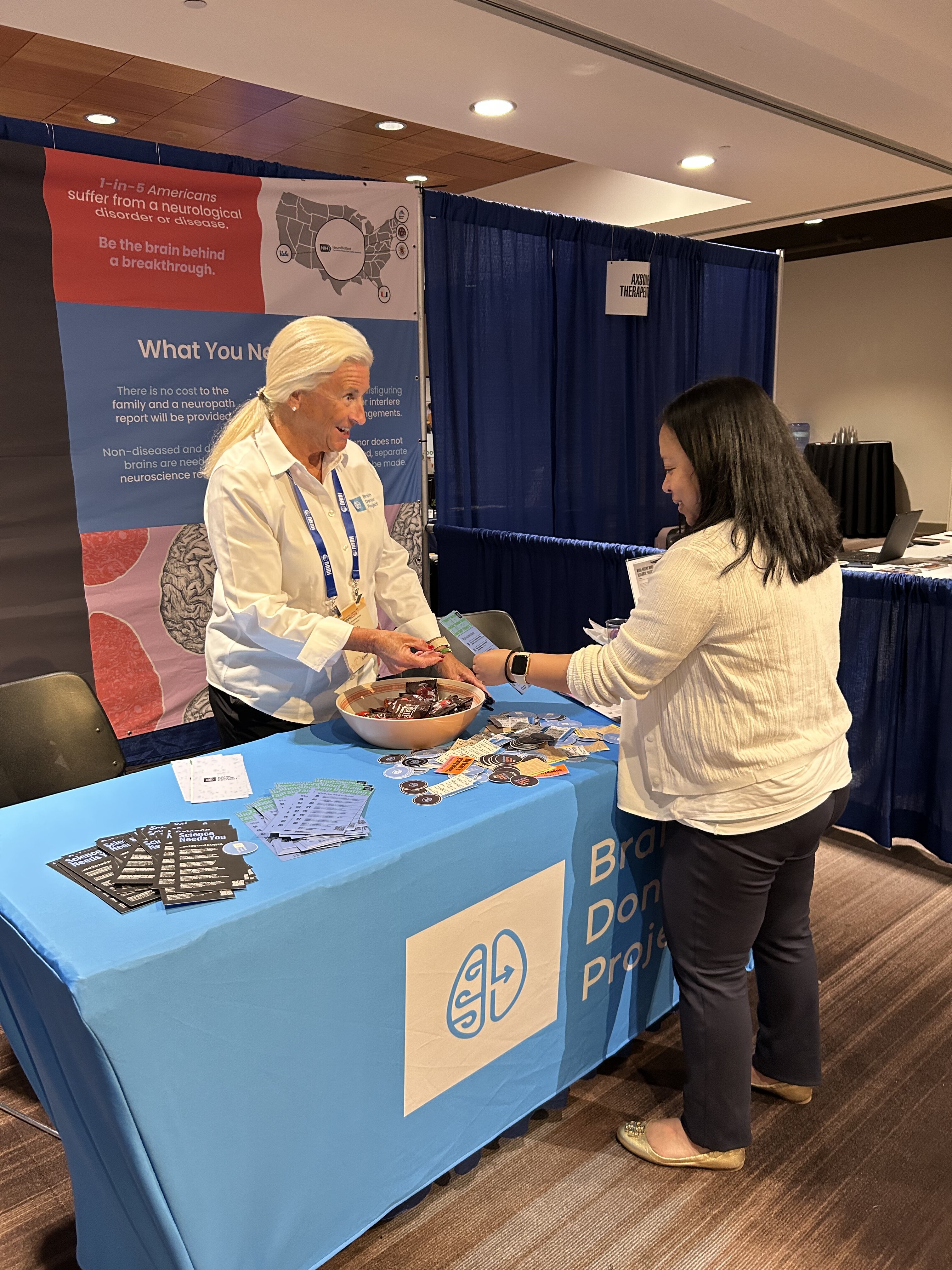 Maybe a serious mental health issue will arise. We talked with attendees at the annual meeting of the National Alliance on Mental Illness (NAMI) last month. (That’s The Brain Donor Project CEO Tish Hevel talking with attendees at NAMICon last month.) It is donated brain tissue that will lead neuroscientists to the source – special kinds of biomarkers – to finally move this field beyond hit or miss efforts at treating symptoms.
Parkinson’s Disease (PD) might show up. Since the focus in PD is a tiny piece of anatomy in the mid-brain that misbehaves, a shortage in supplies stops research.
Which leads us to the second critically important truth happening right now: We need help – and we’re looking for our partners in the patient advocacy space, to step up.
It has become quite clear that people are learning some things about brain donation on their own and are reaching out to their trusted advisors, who in many cases, have helped them learn more about and manage their own disorder. Now they want to talk about brain donation with their trusted advocacy organization. But it is nowhere to be found on their websites. And guess what happens when one enters “brain donation” as search terms on the website of neurologic-based non-profit organizations, as most patient advocacy groups are? The user is seriously bombarded with copy including the words “brain” – of course, it’s a brain disease website. Or the word “donation” which is also logical, as non-profits need monetary donations. It’s clear that one would have to scroll through nearly every word on the site to maybe come across anything relevant.
But it is alarmingly relevant. And missing. Which does not serve any community well when people with lived experience are seeking information about how they can contribute to cures and treatments by donating something they don’t need anymore.
This isn’t a tangential topic. Nor is it a request to ignore because who among us isn’t busy/stressed/overworked/focused on other things. And it isn’t simply that we cannot do this work alone. Brain donation is absolutely critical to scientific discovery into what’s causing the disorder central to many organizations’ entire mission.